November 9, 2025
Self-limiting beliefs are sneaky. They sit quietly in the background, shaping how we see ourselves, our work, our relationships, and even the way we walk into a room. They become invisible scripts that tell us who we are and who we can’t be.
For me, that script began early. And its headline read: “I’m not good enough.”
I can trace this belief back to my childhood – a time filled with comparisons, casual comments, and the unspoken hierarchies of talent that exist in most families. My sisters were both gifted in their own ways – one artistic, the other academically bright. I, on the other hand, was erratic at studies – good in some subjects, hopeless in others. And artistic capability, especially when it came to drawing or craft, wasn’t really my forte.
I still remember the moments that reinforced the idea of not being “enough.” Hearing the elders of the family say, “Itna bhi nahi aata?” or “Usko dekho,” when comparing me to others. The endless references to the mythical Sharma ji ka ladka. And the casual comments about how I looked – a gawky teenager with pimples, glasses, and curly hair. I was once told, “Don’t wear glasses; ladka nahi dekhega.”
Somewhere in those comments lay an unspoken message – that I wasn’t smart enough, pretty enough, or talented enough. And because I struggled with math, it automatically meant I wasn’t “intelligent.”
Even back then, though, I had a quiet resilience. I didn’t always crumble. I pushed back in small ways – choosing subjects I loved, studying history despite others raising their eyebrows. But the belief had already taken root
Years later, in my first few jobs, it showed up again – this time, not as a whisper but as a roar.
I once worked with a manager who was particularly mean. Her words could slice through confidence like a knife through butter. I remember the day she screamed at me so loudly that the entire shop floor could hear it. I was frozen – humiliated and terrified. For days, I dreaded coming to work. I finally waited for her to leave town before I could muster the courage to resign.
That experience broke something in me. It reinforced every old story I had told myself: maybe I wasn’t good enough, maybe I wasn’t intelligent enough.
Thankfully, my next workplace was filled with warmth and kindness. But that inner voice – the one that said, “You’re not good enough” – didn’t go away. It became quieter, yes, but it lived on. It showed up in moments of hesitation, self-doubt, and comparison.
Then, years later, during my Transactional Analysis (TA) journey, I encountered my belief head-on. In one of the script workshops, I began to uncover what had really been running my life. I realised this voice – the one constantly pulling me down, laughing at me when I did well, whispering “It’s just luck” – wasn’t truth. It was conditioning.
That was phase one: uncovering.
Then came unpacking – going deeper into where this belief came from. Revisiting my childhood, recalling the voices and moments that shaped my sense of self-worth. The comparisons, the criticism, the times I felt unseen.
And finally, came unblocking.
This was the hardest yet most liberating phase. It involved reframing that old belief into something more compassionate, realistic, and growth-oriented. Slowly, “I’m not good enough” started to shift.
It first became, “It’s okay, I don’t know enough.”
Then, “I’m still learning.”
Later, “I’m not perfect, but I will get there.”
And eventually, it evolved into, “I’ll do the best I can with the information available to me — and that’s enough.”
Each reframe felt like peeling off a layer of judgment and replacing it with gentleness.
I also embedded this new belief into tangible behaviours. Speaking up even when my voice shook. Acknowledging my achievements without downplaying them. Asking for help without shame.
What permissions would you like to give yourself in order to access your full potential?
One of the turning points for me was during that TA script workshop when others shared how they saw me. Their reflections shattered my self-perception. It was painful — I cried that day. But in that moment, something shifted. I realised that I might often feel like I’m free-falling, but I never really hit rock bottom. Somehow, I always find a way to rise.
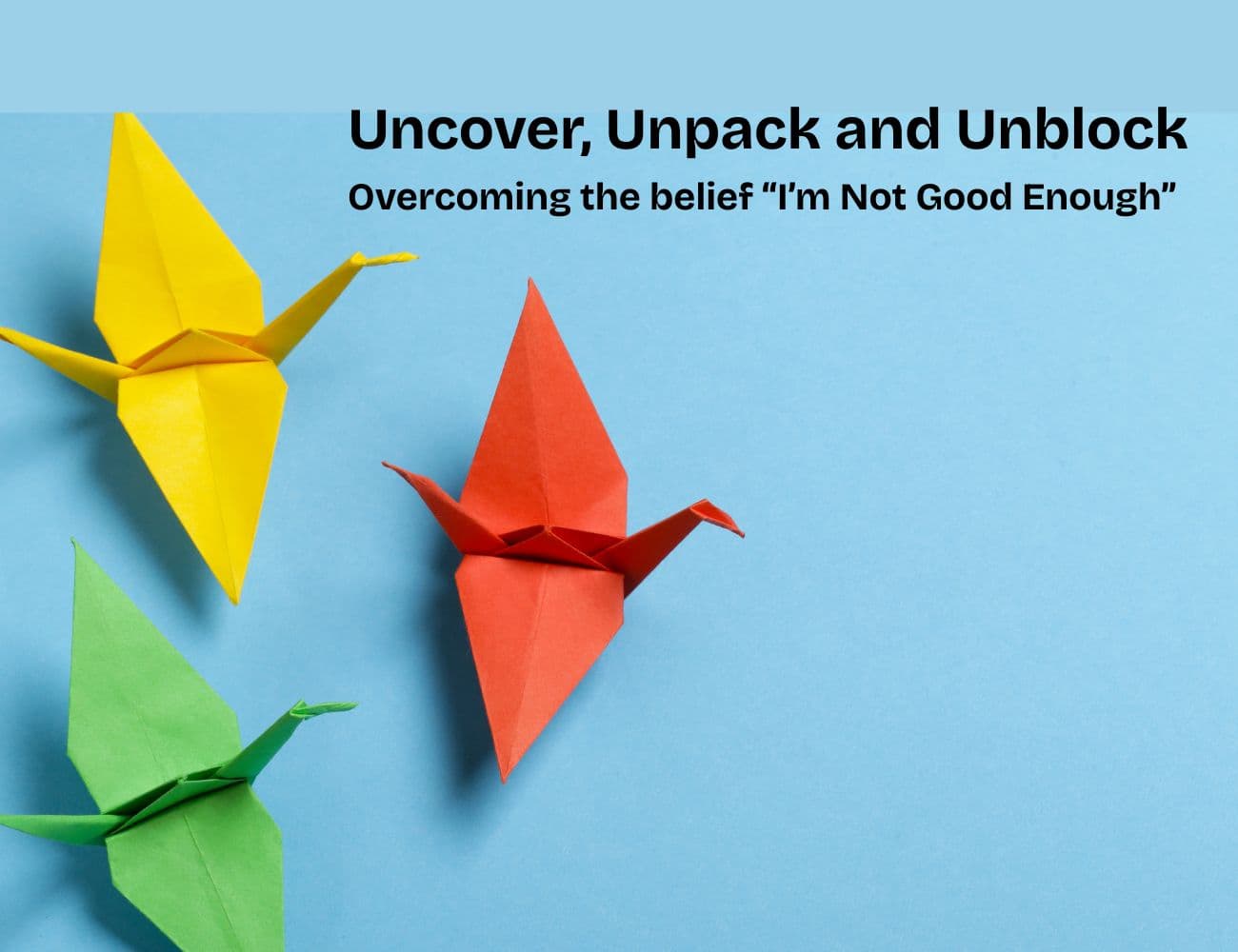
Recently, I came across an article in the Harvard Business Review that described this process beautifully – Uncover, Unpack, Unblock.
That’s exactly what my journey has been.
Uncovering the belief that’s been holding me back.
Unpacking where it came from and how it shows up.
And unblocking it – by reframing, healing, and rebuilding from a place of awareness.
Today, when I look back, I can still hear that voice sometimes. It hasn’t disappeared completely. But it no longer defines me. I can look at it, smile, and say – “I see you. But I know who I am now.”
I am not perfect.
I may not know it all.
But I am learning, growing, and doing the best I can.
And that, I’ve learned, is good enough.

Neetu is a lead facilitator at Navgati, bringing her unique blend of warmth, creativity, and deep expertise to a wide range of leadership development programs. Whether it’s leadership skills for first-time managers, interviewing skills, business communication, women’s leadership, or personal effectiveness, she has a way of making learning feel natural, engaging, and deeply relevant. Over the past decade, she has facilitated over 500 workshops for organizations across industries—IT, manufacturing, logistics, FMCG, hospitality, aviation, and e-commerce—partnering with companies like Daimler, Flipkart, TATA Motors, Oberoi, Air India, Airbus, and Siemens Healthineers, to name a few.

 Stackbrix